In 1993 The Newberry Library hosted an exhibition of manuscript letters of Thomas Jefferson. The following passage from a letter he wrote when he was seventy-six years old caught my eye:
"In no circumstances has nature been kinder to us, than in the soft gradations by which she prepares us to part willingly with what we are not destined always to retain. First one faculty is withdrawn and then another, sight, hearing, memory, accuracy, affections, & friends, filched one by one, till we are left among strangers, the monuments of times past, and specimens of antiquity for the observation of the curious."
Some time later, I wrote the following poem in response to Jefferson's idea that a person ought to approach death with resignation:
Thomas Jefferson’s Old Age
Quite late in life, as every organ ailed,
Old Thomas wrote, “Infirmities entailed
by age are Providence’s kindly gifts.
She takes our faculties and stepwise lifts
from us our friends, our appetites, until
we turn without regret and cross the sill.”
I mark Tom’s subtle words and graceful phrase
in that quick letter sent in his last days.
They glint as bright with fearless love
as when before a prince he cast the glove.
But I can not join Tom in grateful praise
of Heaven’s harsh and stern unbending ways.
Each failure that emerges with my age
makes my resentment deeper, feeds my rage.
Slow mile, fat middle, feeble arm
give proof each day how grave’s the harm.
I say to Tom, “Your stoicism’s rot,
and only possible if you’ve forgot
those days in Paris when you strode the wide
bright avenues with Sally by your side.
When passion lifted wit into the air
with moon and clouds, suspended there.
If you remembered still those days, that sky,
how could you ever turn from us and die?
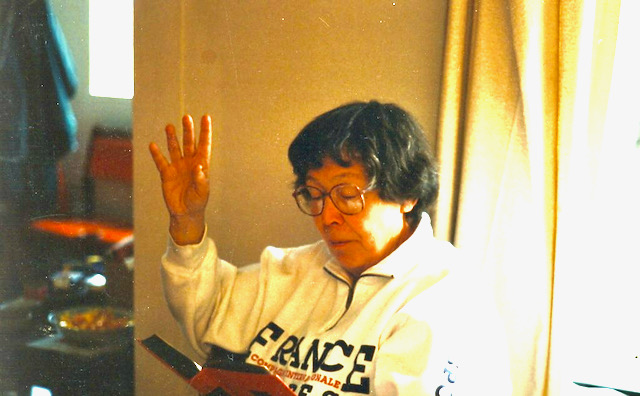
I now recognize that the poem is not very good. (And it's rather funny that already at age forty or so I was complaining about falling apart physically.) At the time, though, I was very proud of it, and I sent a copy to my mother. She responded quickly, but rather than giving me the praise that I had hoped for, she chastised me with the following:
Rebuttal
Young man! Slow down, and buy a rich toupee.
You haste, you tread upon my slipshod heels.
I’m in the vanguard now, have been for years.
Your “feeble arm” could knock my (false) teeth out.
Write in three decades, let’s see what you’ll say
About how long-endured arthritis feels,
About the aged eye that blinks, squints, blears;
Try osteoporosis, or the gout.
The clever Greek observed this orb from space,
Absorbed by wisdom, felt death as a cure.
Worried about her children, my mother still
Dreamt of humanity’s future in the skies,
A living miracle to her sightless eyes.
My aged friend the doctor wants a pill
From Hemlock to make easy dying sure.
Such endings seem a wise and moderate grace.
When young, my brother came home from a bar
Full of philosophy, said that heaven and hell
Were how one felt at very point of death.
I found it a persuasive argument.
“Do not go gentle,” wrote the drunk Welsh gent.
Well, did he curse or spit out his last breath?
He asked his dad to rage and suffer well
Lest Dylan’s puny love of life should scar.
Visit a nursing home, and hear the moans
Unhappy mutterings, despairing groans.
Dying can be the grimmest job we do,
Or not, Tom Jefferson was right. He knew.
Morituros Salutamus.
Ave, nostre bone Thomas!
Even now, decades later, I'm not sure I agree with my mother's point of view, but I do appreciate the elegant way she put it. |