
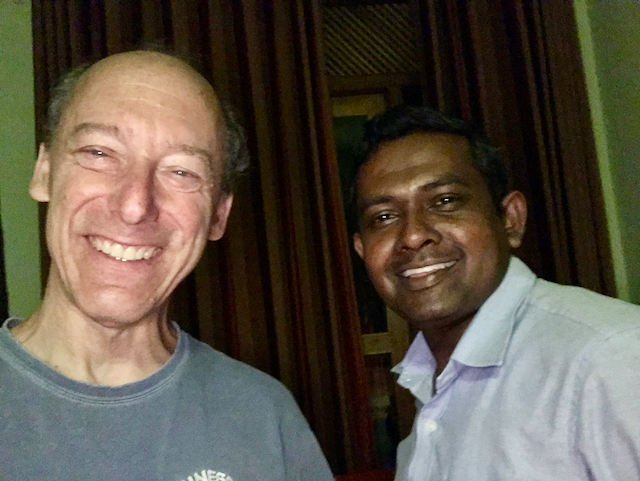
| From the age of four until the end of junior high school I attended the Northern Illinois University Laboratory School, a small school where many of the students were, like me, children of faculty members. Despite the name of the school, most of the curriculum was not experimental (the exception was math, where we spent most of our time learning Venn diagrams, rather than doing actual arithmetic). But one unusual feature was French class. In fourth grade we started with twenty minutes a day of French, and that grew by ten minutes a day the next two years. I was good at French, enjoyed it, and went on with it through high school. During high school I got interested in becoming more observant, and along with that I began to study Hebrew. I used Hayyim Rosen’s Textbook of Israeli Hebrew, from which I learned a great deal. I also tried to learn some Arabic, and though I didn’t get as far with that, I did make some significant progress. I bought (Where? I have no idea.) a copy of Wright’s Arabic Grammar, and though I didn’t know enough to get much out of it, I liked to carry it around with me in high school. (Even that far back, I liked to have a book in my hand wherever I went. I still do.) I loved the orderly tables of verb forms, and the similarities between Hebrew and Arabic fascinated me. I also picked up a bit of Egyptian colloquial Arabic by talking to a classmate whose family had recently come from there. At about that time, the university decided to offer a class in Hebrew. They had some difficulty finding someone to teach it, so they asked my father, who was ordinarily an English professor, whether he could do it. He got a few books from Rosenblum’s bookstore, which was then on Lawrence Avenue in Chicago, and learned enough to teach the class the first year. In reaction, the small group of Arabic-speaking students on campus put together a non-credit class in Arabic that met in the evening. I attended that class, taught by Saad Sowayan, who later went back to Saudi Arabia and had a successful scholarly career. I was almost the only student. I had always figured that I would become some kind of scientist. Maybe an astronomer, because I had a telescope, and loved to use it. However, in my Junior year of high school I realized that I just wasn’t that good at math, and I knew that I wasn’t going to be an astronomer or a physicist without excellent ability in math. So, based on the pleasure I took in learning and comparing languages, I thought of linguistics. I decided that would be my major in college, and bought a couple of introductions to the field, which I read, but only dimly understood. In college I studied linguistics, Hebrew, and Arabic. I took all the courses they offered in those languages, did well, and enjoyed it. Looking at the Hebrew I know today, I realize that I learned most of it during those few years. When Avi asks me about some word, and I know what it means, it’s usually because I picked it up during the three years that I was in Champaign. I made my first trip to Israel in the summer between my second and third years of college, and was there for three weeks, ecstatic at seeing Hebrew everywhere, hearing it all around me, and speaking it. I could already speak fairly well, and that was very satisfying. I spent a day or two in Arabic-speaking Akko, so I got to use my Arabic, too. I guess that was the first time I had a certain kind of very exciting and rewarding experience that was going to become very important to me: I was in a place where everyone around spoke a foreign language, but I was somewhat competent in it as well, so that I could communicate with the people around me, and understand what was written on signs. I came back from the trip exhilarated. For the first three years of my graduate studies I received a government scholarship that paid my tuition and gave me a stipend to live on, on condition that I take courses in Arabic. In my first year I took the intermediate Arabic course taught by a new instructor named Faruq Mustafa. Faruq was having some personal difficulties, and at that moment he was not the best teacher. After the first quarter none of the other students wanted to continue with him. I had no real choice, and in any case, I liked him better than the other students did, so I took the course again in the second quarter. I was the only student. Faruq decided that we would read a novel together and discuss it in Arabic. I told him that I couldn’t do that. He told me that I could and would, and for that quarter we met in his office two or three times a week and read اللصّ والكلاب . At the beginning I could barely put together a sentence, but after a few weeks I had got much better, and by the end of the quarter the improvement was significant. That quarter with Faruq became my model for how to learn a language: intensive one-to-one tutoring with a native speaker. My Catalan and Sinhala learning in the last few years has followed the same approach that I learned from Faruq in the first months of 1976. Before Bev and I got married, in the summer of 1977, I participated in a summer Arabic study program in Cairo called CASA. For two months we had daily classes in both written and spoken Arabic. I loved it, learned a great deal, and found it very satisfying. After the end of the course we had a free week to go wherever we wanted. I flew to Athens and then got right on a plane to Israel, where I spent the week. This was before Sadat’s visit to Israel, and it was very exciting to get up in the morning in Egypt and go to bed at night in Jerusalem. After two months of intensive work, my Arabic was probably better than my Hebrew, but the Hebrew came right back when I started to use it. Both Egypt and Israel were fresh and new and exciting to me. During the following decades, while I worked at ComEd (later Exelon) programming computers, I continued to study languages, and did serious research on two dialects of Neo-Aramaic, in the process learning to speak them somewhat. However, I had a growing dissatisfaction with my practical language skills. As a linguist, I was always learning about languages, but never getting very good at actually speaking them. I wanted to pick some language and invest a lot of time in learning it well. I learned a little Russian to help me with my research on Bohtan Neo-Aramaic, because the speakers mostly lived in Russia or Georgia and were fluent in Russian. But Russia is a harsh, unpleasant country, and I wasn’t sure I wanted to spend an extended period there. At the beginning of 2009, a few months after Bev passed away, Renana went on a study abroad program in Spain. She registered for a program in Ávila, which sounded exciting, but as the time of her departure approached, she decided that Ávila, a small city where she knew no-one, would be too hard for her at this very difficult time. She switched to a program in Barcelona, where some of her friends would also be studying, and where there was some Jewish presence. In February I came to visit. I knew that Barcelona was in the Catalan-speaking area, and I had looked at a Catalan grammar at some time long before. For that matter, like many linguists, I had spent a little time with elementary grammars of many languages. On my shelves today are grammars of Hungarian, Coptic, Tagalog, and Tashelhit Berber, to mention only a few languages I have studied though they have little or no connection to Neo-Aramaic. From paging through a Catalan grammar long before, I had the impression that the language was more complex than Spanish, which has always struck me, (unfairly, no doubt) as being cartoonishly simple. So I bought an introduction to Catalan, and studied it a little before my trip. I enjoyed my visit with Renana in Barcelona enormously, and had fun practicing my Catalan. I quickly discarded my plan of learning Russian and substituted Catalan. The attractions of the place and the people made the decision inevitable. Catalunya is beautiful, both in terms of the natural environment and the constructed environment of the cities and towns. The climate is mild and encourages spending time outdoors. As a result, much of life in Catalunya is lived at cafe and restaurant tables in the open air. People commonly go shopping on foot, in shops just around the corner from their homes. Catalan culture is attractive, and feels very comfortable to me. The Catalans themselves tend to be talkative and friendly. I suspect that many Catlans participate in the general European anti-semitism (though I have never personally experienced this), but in my experience that tend to be interested in Jews and Judaism, and they share with us a devotion to learning and to good sense. There are also plenty of good novels to read in Catalan, and reading them is possible from an early point in learning the language. On top of that, there is a lively press, and an excellent television station with all kinds of high-quality original programs. After my first visit to Barcelona, when Renana was studying there, I started to return every year for a week or two. I managed to meet a few people, whom I could visit every time I was there. On one visit, I came with Avi, and we spent a week in and around Girona, which is a magical city. After my retirement, I increased my visits to a month, including a week in Mallorca. As with any minority culture, the Catalans are used to being overlooked and ignored, and when someone from outside takes the trouble to learn their language they are both surprised and delighted. At home, I arranged a tutor to meet with weekly, and this made it possible for me to progress far more quickly than I could ever have done without him. My first tutor was Toni Bernadó, who was teaching Catalan at the University of Chicago. I learned an enormous amount from Toni, and enjoyed getting to know him. After he left Chicago and returned to his home town of Tremp, in the foothills of the Pyrenees, I started to visit him there once a year, and I have found that my relationship with him has deepened as the years have passed. After Toni left Chicago, I found Helena Aparicio, a native of Mallorca, and worked with her for several years. I both enjoyed learning the new dialect and getting to know Helena. When I met her I already spoke Catalan fairly well, and that in itself created a sort of closeness between us. After Helena left Chicago I studied for several years with Alba Girons, who teaches and directs the Catalan program at U of C. I feel that the relationship between a devoted student of a language and a sympathetic tutor who is teaching his native language is something special. The learner is paying a great compliment to the tutor through his interest in the language, which is an essential part of the tutor’s identity. The tutor reflects back on the student his own pleasure in being validated and appreciated for his essence. When, after years of thinking about it, and idly considering the timing, I finally picked a date to retire, I decided to use my new freedom to travel, and to take an extended, exotic trip immediately after leaving work. Having plenty of time, I could go anywhere. A couple of years earlier, in an issue of the Lonely Planet magazine, there had been a paid supplement for Sri Lanka with gorgeous pictures and interesting text. So when I started to think of where to go after my retirement, Sri Lanka came immediately to mind. My impression, since confirmed, was that it would be beautiful, interesting, and warm. I don’t remember considering any other possibilities. I didn’t know anything about Sinhala, and I certainly didn’t pick the country because of the language, but I was not going to spend a month in a country without making an effort to learn at least a little of the language, so I went to the library and got out some books about Sinhala. I also Googled Sinhala teachers, and came up with an Englishman named Michael Meyler who offered classes in Colombo. I emailed him and asked if he would do a few private lessons for me when I arrived, and he said no, but suggested that I buy his book. I was disappointed, but then he emailed again, said that he would be offering a short intensive class in Galle just a few days after I arrived, and asked if I would be interested. I most certainly was! The class was excellent, I learned a lot, and I met a few other people, which I also enjoyed. When I came home, I managed to find a tutor who could spend an hour a week with me, and when she left town a year later, she found a successor for me. And every time I return to Sri Lanka I arrange tutors. I have particularly enjoyed and profited from working with Buddhika Konara. As with Catalan, my Sinhala tutors and I have both enjoyed the relationship. They are pleased that someone is learning their language, and are consistently complimentary and encouraging. This brings me to one of the most important aspects of my experience as a language learner over the last few years. I have been working on Catalan and Sinhala, two languages which are rather rarely studied. For foreigners Catalan is overshadowed by Spanish. Many people who visit the Catalan countries are unaware that the language exists, and if they try to learn some of the local language, they think only of Spanish. If they do know about Catalan, they still tend to learn Spanish, because it is used far more widely, and if utility is your main criterion, learning Catalan seems a waste of effort. As for Sinhala, most Westerners have no idea where Sri Lanka is, and if they could find it on a map, would never wonder what language might be spoken there. One English visitor whom I met in Colombo was surprised to hear that Sri Lanka had its own languages. He seemed to think that there was only one language spoken throughout India and Sri Lanka. So in both cases, it is rare for outsiders to learn the language, and if you do learn even a little, you instantly vault from annoying tourist to cherished friend. This, in contrast with the situation with frequently-studied languages like French or Italian. A student of those languages is far from unusual in the experience of the native speakers he encounters. It seems natural to them that he would want to learn their language, and they have met other foreigners who speak it far better than he does. He will get no compliments, or at least no sincere ones, and his interest in their language and culture will not open doors. In short, learning languages has brought me pleasure and satisfaction for my whole life, and the addition in recent years of Catalan and Sinhala has been delightful. |
| Created on 13 July 2022, updated on 15 July 2022 which is nothing special by Samuel Ethan Fox |