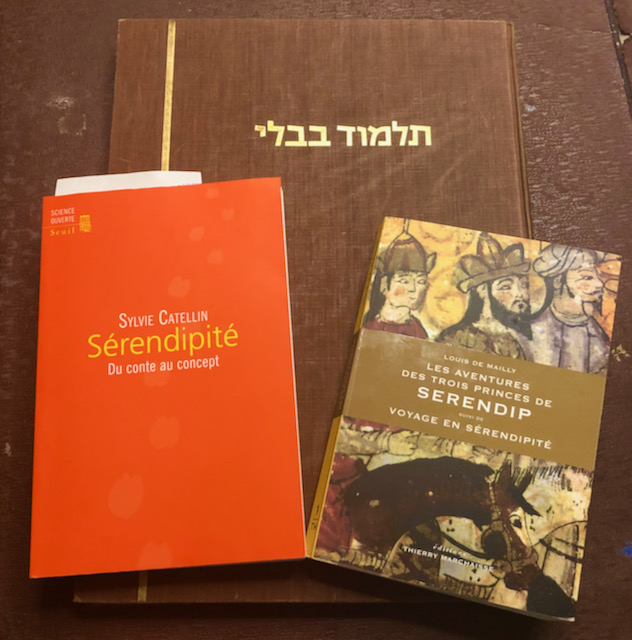
| I should make it clear that little of what follows is at all original. A whole intellectual industry has grown up around the word Serendipity, and I encourage you to dip into it. This was originally given as a dvar Torah at Mah Tovu. There is an old joke about a writing class to which the teacher has assigned an essay on “The Elephant.” There are students of various nationalities in the class, and their essays betray their origins. There is a Frenchman, and he has written about “The Love Life of the Elephant.” An Englishman has written about “Elephant Hunting.” The last essay is from a Jewish student, and his essay is entitled “The Elephant and the Jewish Question.” The point of the joke is that the Jew relates everything, even elephants, to his parochial concerns. The joke is not as funny as it used to be because the phrase “the Jewish question” has practically disappeared from use. A hundred years ago there was a prevalent idea that everyone in the world belonged to a nation, and every nation had, or ought to have, a land and a state. The French lived in France, the Italians lived in Italy, the Germans lived in Germany. But the Jews were scattered everywhere, and had no state. What to do about this anomalous situation was “the Jewish Question.” Since then, the world has changed considerably, and after the murderous destruction of most of European Jewry and the creation of the State of Israel, the Jewish Question has lost much of its urgency. Nevertheless, Jews, even more than most people, still tend to see the world in terms of their own concerns. We will conclude by returning to this idea, but first let’s turn to a man named Horace Walpole (1717-1797). His father ,Sir Robert Walpole, was the first prime minister of Great Britain, and Horace was a bit of a politician himself. However, he was better known as a litterateur, and wrote novels, the best-known of which is called “The Castle of Otranto.” He also maintained a very extensive correspondence, which sheds light on all kinds of aspects of his world, and has been published in 48 (!) volumes by the Yale University Press. In one of his letters, written in 1754, Horace mentioned that he had been reading a book called “The Three Princes of Serendip” in which the princes wander the world, “making discoveries, by accidents and sagacity, of things which they were not in quest of.” He said he had coined the word “serendipity” to describe this combination of accidents and wisdom. Walpole then gave a real-life example of serendipity: A friend of his had been at a dinner party where he noticed that the mother of a young lady also present was showing her daughter great deference. He deduced from this that the young lady had just got married to the nobleman who had been courting her. The Three Princes of Serendip that Horace was reading was a French book, very loosely translated from an Italian version. The story is that the three princes had been kicked out of their country by their father, who wanted them to go out into the world and have some real experiences. (Incidentally, Serendip is an old name for Sri Lanka. It was a very remote, little-known place, and its name added an exotic flavor to the book.) Very early on in their wanderings they find themselves walking with a camel driver who has lost one of his camels. They have seen the tracks of a camel, and on the basis of what they have seen they ask him if his camel was not blind in one eye, missing a tooth, and lame. He says that is all true. They point him in the direction that the tracks led, and he goes off after his camel. He goes some way without finding it and comes back to them. Now they add more details about the camel, based again on what they deduce from its tracks: It was carrying a barrel of honey on one side and a barrel of butter on the other. A lady was riding it, and she was pregnant. All this, the camel driver confirms, is true. But when they all arrive at the city where they had been going, the camel driver has the princes arrested. He is sure that there is no way they could have known all this about his camel unless they had stolen it. They are brought before the king, but before they can be tried, someone finds the camel and restores it to its owner, so they are set free.. Now the king wants to know how they could possibly have known all these things about the camel without ever having seen it. They explain that they knew that
The king is very impressed by all of this wisdom, and invites them to stay with him for a while. While living with him in the palace they further demonstrate their acumen, but those further demonstrations are not so relevant to our point. The story of the camel had already been around the block when the Italian and French versions were published. The author of the Italian version had got it from an earlier Persian version, and it also appears in Arabic within one of the stories of the Thousand and One Nights. However, the very earliest surviving version of the story is in the Babylonian Talmud (starting at the bottom of Sanhedrin 104a) Here it is: There is a story about two people (Jews) who were captured on Mount Carmel and their captor was walking behind them. The version in the Talmud is the first one recorded, but the story likely had already been around for a while. There is no intrinsic Jewish connection to the camel story, any more than there is anything Jewish about elephants, but the Talmud gives it one: The moral of this version of the story is not that it’s good to be wise and observant, but rather that God has given the Jews wisdom. For the Talmud, the Jews’ relationship with God is all-important, and they owe it to the merit of their Fore-fathers and -mothers. In that spirit, I dedicate this to the memory of my father, Arnold Fox, who passed away twenty-three years ago. |
| Created on 19 May 2021, updated on 8 September 2022 by Samuel Ethan Fox |