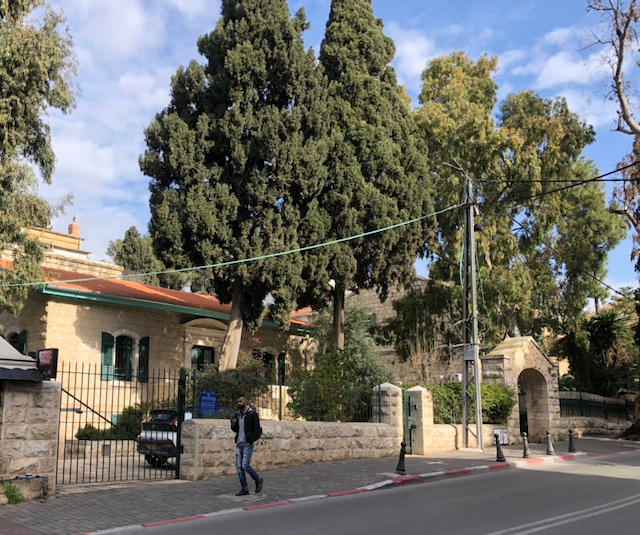
| Avi and I are staying in a Jerusalem neighborhood called Baka. On the edge of the neighborhood, towards the center of the city, there is a group of large houses called "The German Colony". Since we are very close to the colony, I wanted to learn a little about its origin. It turns out that it was founded in the late 19th century by a group of Germans whose ideas had gradually distanced them more and more from the norms of Lutheranism. They believed that the second coming of the messiah was imminent, and since they emphasized the concept that the body of each believer was a temple of God, they were referred to as the Templers. Some of the Templers moved from Germany to Palestine in the hope that this would precipitate the second coming. In 1867 the first group that arrived in what is now Israel tried to create a rural settlement in the Jezreel Valley, but they were completely ignorant of local conditions and almost all of them died of dysentery within the first year. Two years later, other groups of Templers who were better prepared and organized began to arrive in the country and founded colonies in Haifa, in Jaffa, and in Jerusalem. Among them were architects and craftsmen who built large stone houses that have endured. The descendants of those Templers remained in Israel until the period of the second world war, when they were deported as enemy aliens. Some of them, at least, were indeed enthusiastic Nazis. Every year, during my stay here, I read a novel in Hebrew. This time I’m working my way through Roman Russí (“Russian Novel”) by Meir Shalev, which is a fictionalized account of the people who came from Russia at the beginning of the 20th century and created one of the first Jewish farming settlements in Israel. Two weeks ago I read the Wikipedia page that mentions the first failed settlement of the Templers. Coincidentally, only a day later I came to the point in the novel where the narrator's grandfather tells him stories about the surroundings of the village. The grandfather mentions that before he and the other founders arrived, a small group of Germans had tried to found a settlement in the same place but almost all of them died of endemic diseases in the first few months. He tells his grandson that the ghosts of those Germans can still be seen at night. The Templers were not the only sect that left Germany in the 19th century. Other groups migrated to the Ukraine and the Caucasus to form new communities in remote places where they hoped to live a pure and simple life. Years later, during the First World War, groups of Assyrian refugees arrived in Russia from Turkey, and the Red Cross needed to find places for them to settle. Some of them were sent to German villages in the Caucasus, where they worked in the vineyards. The next decades were turbulent, but the Assyrians continued to live and work in the same villages until 1949. However, on June 19 of that year they fell victim to the kind of arbitrary uprooting that many ethnic groups suffered under Stalin. At two in the morning, the police knocked on their doors, gave them twenty minutes to collect their belongings, and put them on trucks. Two weeks later they found themselves in Siberia, where they would spend the next seven years working in the forest. Only after Stalin's death were they permitted to return to their homes in the Caucasus. I know their story because almost fifty years later I visited their descendants, who were by then living in Russia, to study their language. Because of the war going on now here in Israel, many agricultural workers have either fled from the country, or are not being permitted in. As a result, there is a great demand for volunteers. Avi and I have been going once a week to the settlements around Gaza which were attacked to help them pick fruit. Sometimes someone from the settlement will tell the volunteers a bit about what happened there on the day of the attacks. When I was at Kibbutz Nir Am, one of the residents described how their small self-defense group had been able to keep the attackers out of the kibbutz, until help finally arrived, hours later. Then he added this: The night after the attack, at two in the morning the authorities knocked on their doors, gave them twenty minutes to collect their belongings, and put them on buses. The government did not believe they would be safe in their homes, and had found temporary housing for them elsewhere. The story of being awakened in the middle of the night and given a few minutes to gather belongings immediately reminded me of the Assyrians in 1949. The circumstances are starkly different: the Assyrians were being discriminated against and exploited, whereas the residents of Nir Am were being taken to safety. Still, in both cases whole communities were suddenly and traumatically taken from their homes, with no idea of when they might return. Those of us who have lived lives free of such violent and disturbing disruption should reflect on our good fortune and appreciate it. |
| Created on 24 February 2024, updated on 22 August 2024 by Samuel Ethan Fox |
| Comments on this entry |
| Thanks Susie |
| Thanks Sam. Facinating. |
| Masorti shul in Tel Aviv Liz |
| There is a beautiful Templar building in Tel Aviv that is a Masorti shul if you ever find yourself there for Shabbat. We... |
| German Colony Larry |
| Thanks for all of this interesting information. Without knowing, I always assumed that the founders of the German Colon... |