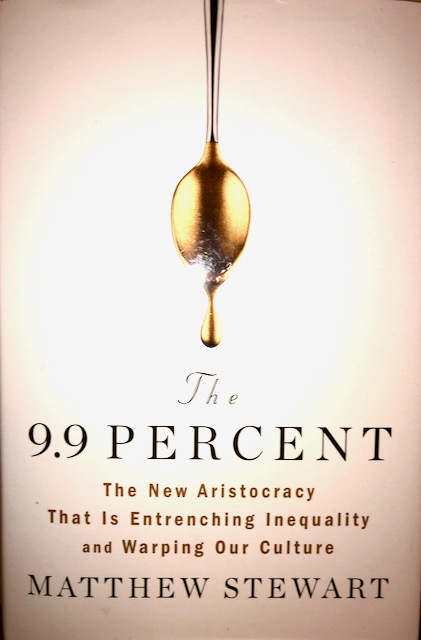
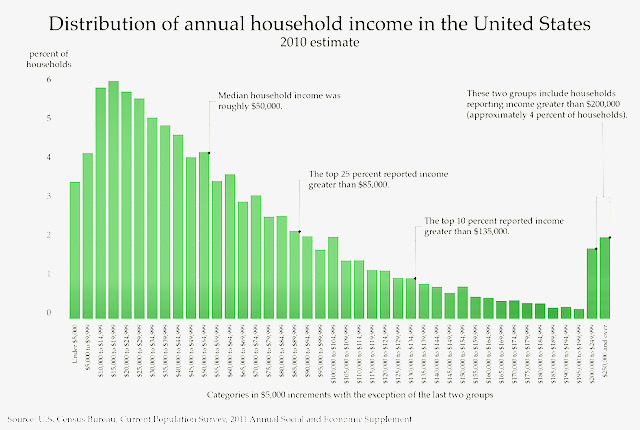
| I just finished reading a book by Matthew Stewart called The 9.9 Percent, The New Aristocracy that is Entrenching Inequality and Warping our Culture. He covers a lot of ground and makes a lot of good points, though most of them are not new. It makes sense to me, and resonates with some things I’ve been thinking. The 9.9% he refers to are the upper middle class, who he feels are benefitting from a political and economic system that is mainly in the service of the 0.1% - the really rich. I’ve written up these notes mainly for my own use, but I thought other people might like to read it. The book is well-written, but he doesn’t always argue his points effectively. In what follows the numbers refer to his chapters. If you'd like to add a comment, you need to sign in. If you don't know your password, send me a message, and I'll give it to you. 2. Around the world extreme inequality is associated with over-parenting. Where the economic slope is steep it seems more important to give your child every advantage. In America now people tend to end up in the same income bracket as their parents more than in the past or in other developed countries. Extreme inequality also correlates with this kind of lack of mobility. 3. People tend to marry others from the same income level, and this perpetuates the income differences. “Class … produces a small group of people who are deluded about the sources of their good fortune and a large group of people who are deceived about the sources of their misfortune.” p. 59 Disempowerment of the lower classes, who have bad, poorly-paid jobs, leads them to be attracted to authoritarian figures. “The authoritarian leader who unites social and economic conservatives is typically not just male, but superlatively male. He is a ‘strongman.’ He is definitely not ‘gay.’ He prizes those women who perform stereotypical femininity unstintingly. To the disempowered men, he offers a model of the virility they wish to have in themselves, a conviction that they have a right to property in women, and the prospect of exacting revenge against those women who do not follow the rules. To disempowered women, he offers the model of a strong provider, the hope for security in a world not organized for their benefit. To the defensive couples that make up much of the middle of society, he offers protection against the loose (or empowered) women and effete men who threaten this precarious order of the genders on which their own sense of security depends.” p. 61. This all applies not just to Trump, but to Putin, Erodogan, Orban, and Bolsonaro. 4. Higher education should be, as it once was, in the service of the public good, not just an avenue for individual advancement. Thomas Jefferson pushed for a lot of money to be spent on schools because it was “not more than the thousandth part of what will be paid to kings, priests, and nobles who will rise up among us if we leave the people in ignorance.” 5. In America today the difference between rich and poor neighborhoods is enormous. The 9.9% is concentrated more and more in certain neighborhoods, and the poor in others. If your house is in the right neighborhood, it increases in value, and without lifting a finger you keep getting richer. All kinds of other advantages that come with having a house in the right neighborhood, like good schools, also contribute to increasing the gap between rich and poor. Living in the right zip code is the best way of defining who is in the 9.9%. The government gives a lot of money to the better-off through housing policy. This includes the mortgage interest deduction, and the exclusion of capital gains tax on inherited homes and on home sales. Almost all of this goes to the 9.9%. A book (which I had never heard of) called Progress and Poverty was written and published by a guy named Henry George in 1879, and became enormously influential. George had been impressed by the contrast between rich and poor parts of New York City, and that started him learning and thinking. He wrote that “Private property in land is robbery. It has everywhere had its birth in war and conquest, and in the selfish use which the cunning have made of superstition and law.” He proposed outlawing profit on the land itself. If you owned a field you could cultivate it and make money from the crops, but if you rented it out, the rent would be taxed at 100%. If you bought land, you could build a house and live in it, but when you sold it, any increase in value would go to the state. Loss of value would also be made up by the state. This is called a land value tax. The basic point about property is that it is wrong for people to make money from appreciation of property that they had nothing to do with. Like capital gains, it’s just a question of sitting around and getting rich, and the tax system is biased in favor of this kind of accumulation of wealth. 6. Meritocracy is a good thing when it means that people should only get positions of authority if they have demonstrated their fitness for them, not because of birth or association with the rich and powerful. It doesn’t mean that if you’re in a position you must deserve it. People tend to believe that the boss must be the person with the most merit, or he wouldn’t be the boss. They also act as if everything good that happens in a company or other group is due to the boss, and he should be compensated accordingly. The idea that merit is compensated appropriately in our society is preposterous. No matter how you characterize merit, no matter what you think are the good qualities that should make for success and be compensated, you can expect to find them distributed through the population in a bell curve, with a few people having very little, a lot of people having a moderate amount, and a few people having a lot. So if income and wealth depend on merit they should be distributed that way, too. But they are not. Instead, we have a lot of people making very little money, some making a moderate amount, and a tiny number making a great deal. I’ve attached a graph from the 2010 census. Things are probably worse now. If compensation were really in proportion to merit, inequality would be far lower than it really is. Merit is often measured by what school you went to, but admission to the “best” schools heavily favors the 9.9%. Universities should “accept everyone who is qualified to make good use of their services” and if they don’t have enough room for the qualified candidates, they should be picked by lottery. We should also accept that a university education is not the only way to become qualified to do useful and important things for society. 7. Antitrust laws have been gutted so that nowadays in America a handful of companies control most sectors. The result is that a lot of things, like internet and phone service, are way more expensive here than in other countries. The companies that benefited from this paid to have the laws made to allow it. Since Reagan fired the air traffic controllers, the government has worked to destroy the free market for labor, favoring corporations at all times. The minimum wage is now almost a third lower than it was in 1968, in constant dollars terms. Economic policy has tended to favor keeping inflation down, rather than keeping employment high. The fact that ALEC called for less government help during the pandemic shows that the rich preferred to see people go back to work and die rather than lose money. With the market so slanted against workers, those who can, have made their jobs “professions” and then restrict entry in order to safeguard their positions and increase their incomes. The result is that the US has less doctors per capita and medicine and dentistry in the US are much more expensive for consumers than they are in other countries. Lawyers also cost Americans much more than they do in other places. He calls for a return to meaningful antitrust laws, raising the minimum wage, and fixing the laws that give corporations an advantage over workers in their relationship. 8. Americans lose their jobs very often, but get much less support when they are unemployed than people in other countries. When the 9.9% lose their jobs it’s bad enough, but when that happens to the poor, they are likely to suffer health problems as a result. Americans pay about $11K per person for health care each year, which is twice as large a part of their income as people in other wealthy nations. “The impoverishment of the many is not an incidental effect of a system that redistributes resources upward; it is a necessary feature of the system. The way to keep the 0.1 percent happy is to keep wages low, and the way to keep wages low is to keep workers desperate.” p. 198 9. “Racial injustice is inseparable from the economic injustice from which it arises.” p. 212. His view is that the basic problem is economic. The rich use appeals to racism to get the support of the white poor, and thus continue their ability to continue to take wealth from everyone, but principally from other white people. That was the case even before the civil war. Progressives think of anti-racism as a personal virtue, but the real problem is economic, and can only be fixed by reducing inequality. Jobs that are perceived as white jobs are overpaid compared to in other countries, and those that are perceived as black jobs are underpaid. Black people are systematically impoverished, and this lays the foundation for racial contempt. Economic and racial inequality grow at the same time, even if there is no increase in the level of prejudice. The biggest economic gains for black people happened in the time leading up to the civil rights movement, not after it started. In other words, economic gains made civil rights possible, not the other way around. Politics for the 9.9 percent is symbolic rather than practical. “It is a place where one goes for spiritual reward, not to secure real change through political action.” p. 235. Having already got their piece of the pie, they are not really interested in changing things. He concludes the chapter by saying that the best (maybe only) way to fix the problems of racism is to have a higher minimum wage, effective collective representation of workers, and taxation of unearned fortunes. “These and other seemingly race-neutral economic policies will decide the course of American racism in the future. The rest is mostly posturing and evasion, which has become something of a fine art in the age of the 9.9 percent.” p. 236 10. Extreme inequality leads to citizens who believe, based on their experience, that things happen due to raw power. They believe that politics is a spectator sport, not a practical way of achieving things. Claims that all their problems are due to “the other” go down well with them. The 9.9% are a very important element in the Democratic party, and they are beneficiaries of the status quo. Therefore the party pushes less for real change than it used to. Right-wing media are far more extreme than left-leaning outlets, which are much closer to the center. The reason is that the extreme rich are a small group with largely coherent goals. Though there are billionaires who have loftier goals, most of them agree on the policies they want and are willing to invest a lot of money in getting them. The right also doesn’t mind lying and inventing; the only important thing is getting their way. The left is more reasonable and more diverse. It doesn’t speak with one voice. 11. In Stewart’s view, much of the solution to these problems can be found in taxation. He quotes Thomas Jefferson who wanted to keep the US from becoming like the France of his day, where almost everyone was poor and a handful were very rich. Jefferson suggested a progressive wealth tax, and an inheritance tax. Thomas Paine wanted something similar - a tax of 10% on estates when the owner died which would be distributed to every citizen partly when he turned 21 and partly as an annual old-age pension. We imagine that the tax system is progressive, that is that it taxes the rich more than the poor. But that’s not true. The rich hire lawyers to game the system, and capital gains are taxed at a lower rate. More importantly, there are a lot of other taxes which are not progressive. When you take it all together, working class people pay about 25% of their income in tax, the middle class pays 28%, and the richest 400 Americans pay 23%. Reform in the tax system, especially as it applies to unearned income is the key, in his view. That’s what we need to be pushing for, along with the higher minimum wage, real antitrust laws, and improved labor representation in wage negotiations. He also refers to a great speech given by Teddy Roosevelt at Osawatomie, Kansas in 1910, where he laid out a progressive agenda. It looks like that speech, together with the book Progress and Poverty are very worth reading. |
| Created on 15 December 2021, updated on 29 March 2022 by Samuel Ethan Fox |